Where the Kunene Breaks
Epupa Falls is a green miracle in Namibia's driest corner, and a meeting place for the Himba.
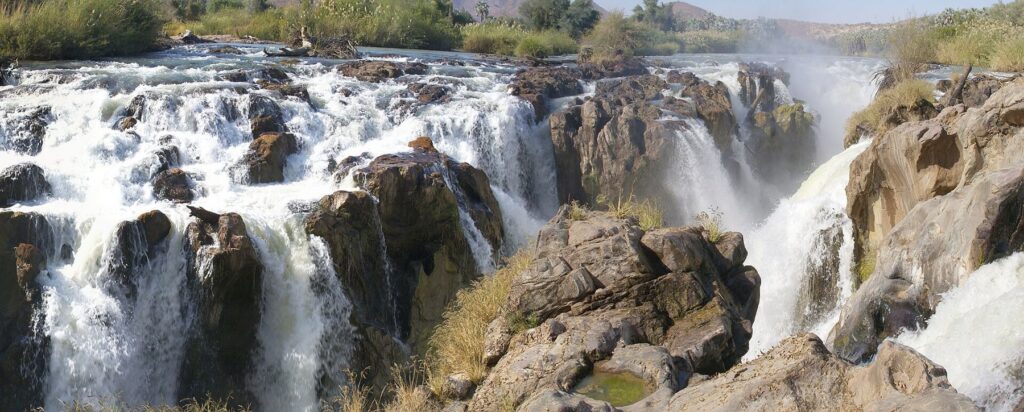
For two days the road north from Opuwo crosses red mountains and dry riverbeds. Then the land drops toward the Kunene, and suddenly there are palms, baobabs and the sound of falling water. Epupa Falls is not one fall but dozens, spread across a kilometre and a half of rock.
Climb the hill above the falls at sunset, when the spray turns gold. Visit a Himba homestead only with a local guide, and on your hosts' terms. Our Namibia journey includes two nights here.
The river on the border
The Kunene rises in the highlands of Angola and flows south and then west to the Atlantic, forming the border between Angola and Namibia for its last few hundred kilometres. At Epupa it reaches a band of hard rock and breaks into dozens of channels separated by islands of baobabs, figs and makalani palms, before gathering into a gorge about 37 metres below. The name is usually said to come from the Herero word for the sound or foam of falling water.
Himba country
Kaokoland is the homeland of the Himba, semi-nomadic pastoralists who move cattle and goats between grazing areas and whose women are known for the red ochre and butterfat paste, otjize, that they apply to their skin and hair. Many Himba families live around Epupa, and the settlement is a place of trade and meeting. Visits to homesteads should be made with a local guide who can introduce you and explain customs; it is the respectful way to visit, and fees go to the community.
In the 1990s a large hydroelectric dam was proposed just downstream of the falls. Himba communities opposed it strongly because it would have flooded graves and grazing land, and the plan was not built at Epupa. The falls remain one of the few great untamed rivers of south-western Africa.
Days at Epupa
Mornings are for walking the riverbanks and the edges of the cascades, when birdlife is busiest; the riverine forest is known among birders for species rarely seen elsewhere in Namibia. Afternoons are hot, so rest in the shade of the palms. Before sunset, climb the hill above the falls: the spray turns gold and the channels glitter below. Do not swim near the falls. The currents are strong and there are crocodiles in the river.
Getting there
Epupa is about 180 kilometres north of Opuwo on a gravel road, and most travellers allow two days' driving from Etosha, with an overnight in Opuwo. Light-aircraft flights save time. Our ten-day Namibia journey combines two nights at Epupa with Etosha and Damaraland, and Epupa Camp sits on the riverbank upstream of the falls. More in our Namibia guide.