Seven Metres of Nile
At Murchison Falls the world's longest river is forced through a gap no wider than a bus. The result is the most violent water in Africa.
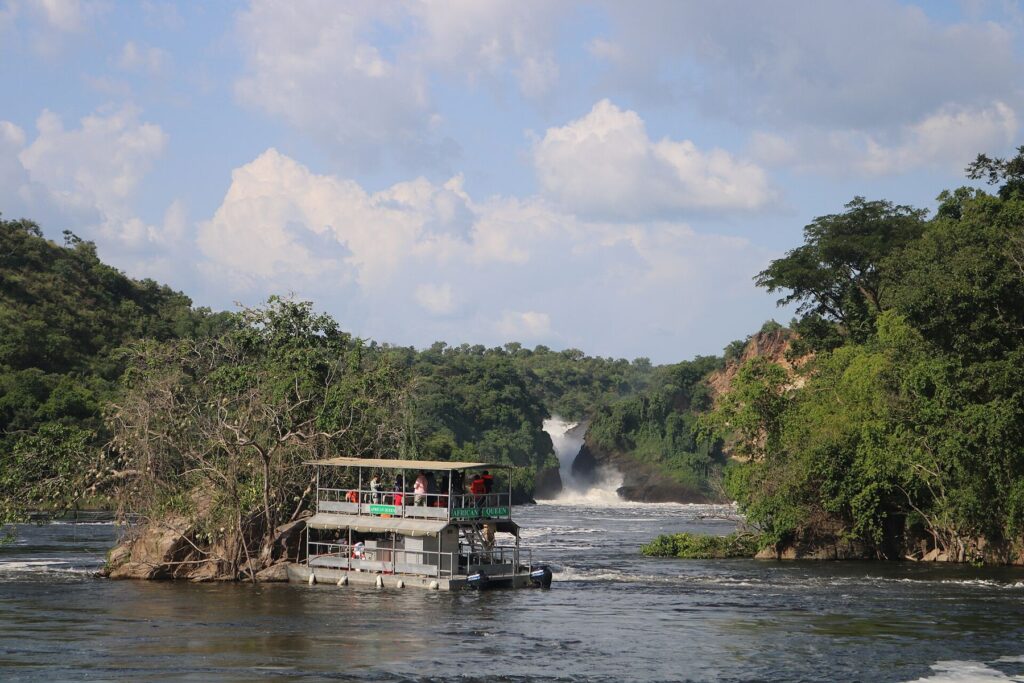
The launch leaves Paraa jetty after lunch and pushes upstream for three hours against a river the colour of strong tea. Hippos surface and submerge on either side. Elephants stand in the shallows. Crocodiles, some of them five metres long, lie on the sandbanks with their mouths open. Then the river narrows, the banks rise into cliffs, and ahead a white column of spray appears above the trees: Murchison Falls.
The boat cannot get close; the current is too strong. But it can drop you at the foot of a trail, and in forty-five minutes of steep climbing you can stand at the top, beside the gap where the entire Victoria Nile forces itself through a slot about seven metres wide. The noise makes conversation impossible. The rock shakes.
Two falls, one river
A few hundred metres away, a second channel, Uhuru Falls, broke through in the floods of 1962. Today both run side by side. Samuel and Florence Baker, the first Europeans to see the falls, in 1864, named them after Sir Roderick Murchison, president of the Royal Geographical Society. Under Idi Amin they were briefly renamed Kabalega Falls, after the king of Bunyoro who resisted British rule.
It is not the tallest waterfall in Africa. It may be the angriest.
Murchison is best done slowly: a dawn game drive on the northern plains for giraffes and lions, the launch trip in the afternoon, a delta cruise the next morning for shoebills. Our three-day Murchison safari does exactly that.
Where the Nile meets the Rift
The Victoria Nile leaves Lake Victoria at Jinja, crosses the swamps of Lake Kyoga and then runs west towards Lake Albert, which lies at the bottom of the Albertine Rift. Murchison Falls is where the river reaches the edge of the rift escarpment and has to get down it in a hurry. Over thousands of years it has cut a narrow slot through the hard rock rather than spreading out into a curtain, which is why the falls are so violent for their modest height of about 43 metres.
Below the falls the river calms down almost at once. It widens into a slow, brown channel lined with papyrus and riverine forest, and runs for some 30 kilometres to its delta on Lake Albert. That quiet stretch is what makes the launch trip possible, and it is where most of the park's hippos and crocodiles live.
The park around the falls
Murchison Falls National Park is Uganda's largest protected area, and the river divides it in two. North of the Nile, the Buligi grasslands are the classic game-drive country: Rothschild's giraffes, elephants, buffaloes, Uganda kob, Jackson's hartebeest and the lions that hunt them. South of the river the land rises into woodland and, further south, the Budongo Forest, home to chimpanzees. More than 450 bird species have been recorded across the park.
The two banks are connected by a ferry at Paraa, close to the launch jetty. Most visitors stay near Paraa and plan their days around the ferry times: a dawn game drive on the north bank, lunch, then the launch trip upstream in the afternoon.
The top of the falls
Seen from the launch, the falls are a white column at the end of a gorge. Seen from the top, they are something else entirely. A short drive on the south bank, or the hike up from the river, brings you to a fenced viewpoint right beside the chute. The noise is constant and physical, the rock is wet with spray and the water moves so fast it looks solid. A few hundred metres away, Uhuru Falls spreads out more gently over a wider ledge.
From the boat it is a view. From the top it is a force you can feel through the soles of your shoes.
When to go and how long to stay
Because the Nile is fed by Lake Victoria, the falls run strongly in every month, so the choice of season is really about the safari. The dry months, December to February and June to September, are best for game drives and the delta boat. The rains, from March to May and in October and November, bring green landscapes and fewer visitors. Two nights is the minimum; three lets you add the delta trip and a morning in the Budongo Forest.
Travelling from Kampala takes five to six hours by road, usually broken at Ziwa Rhino Sanctuary for a walk with white rhinos. Our three-day Murchison Falls safari follows that route, and the Murchison Falls boat trip guide has the practical details of the launch and the delta cruise.